
Cost for Boiler Installation: When Does Work Beyond the Boiler Affect the Final Price?
Understand what affects the cost of boiler installation, from pipework and heating controls to boiler relocation and system preparation. Learn how to compare quotations and avoid unexpected costs.

Why you can trust our content
We understand that the boiler industry can be confusing, with plenty of outdated or misleading information. That’s why we rely only on trusted, proven sources to guide our advice and installations:

At a glance
When planning a boiler replacement, it is natural to start by looking at the price of the boiler itself. However, the appliance is only one part of the overall project. The existing heating system, boiler location and installation requirements can all influence the final amount.
The cost for boiler installation can therefore vary between properties, even when homeowners are considering similar boiler models. A straightforward replacement may require relatively little additional work, while an older or differently configured system may need pipework alterations, new controls or other adjustments.
Understanding what can affect the price helps you compare quotations more fairly and gives you a clearer idea of what the installation involves.
Why does boiler installation cost more than the appliance?
A boiler needs to be connected to several parts of the property before it can operate as intended. Installation involves more than physically mounting the appliance.
Depending on the system, the work may include:
- Removing the existing boiler
- Installing the new appliance
- Connecting heating pipework
- Connecting the gas supply
- Connecting water and condensate pipework
- Installing or adapting the flue
- Connecting heating controls
- Testing and commissioning the system
- Making necessary alterations to existing components
The amount of work depends on the property.
For example, replacing a boiler in the same location with suitable existing connections may be relatively straightforward. Moving the boiler elsewhere could require considerably more work.
This is why an installer should assess the actual installation rather than relying only on the price of the boiler.
If you are comparing quotations, ask what work is included in the installation figure. This can help you understand why two apparently similar boiler replacements may have different prices.
Can the existing pipework affect the final price?
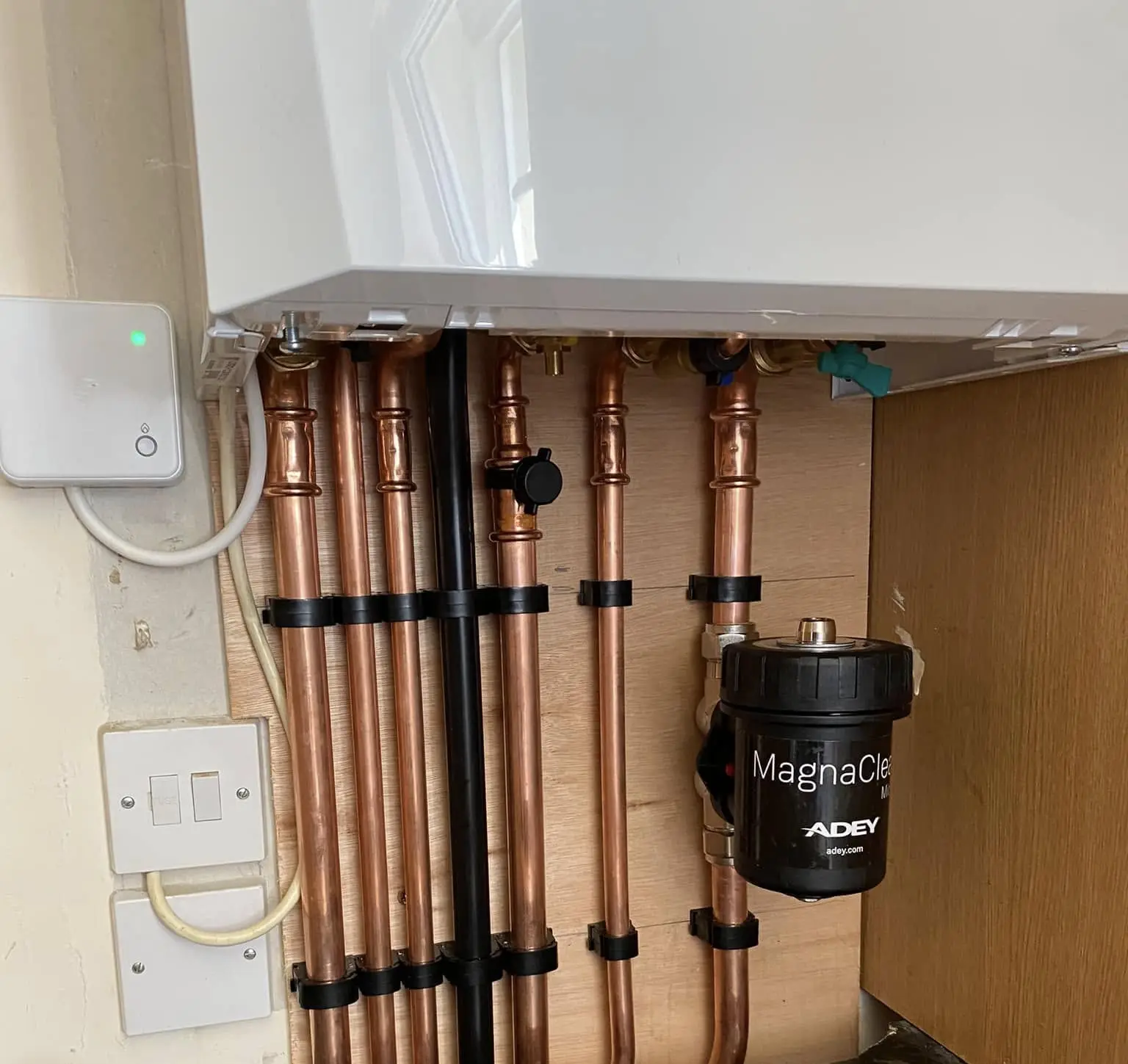
Yes. Pipework is an important part of the heating system and may need to be assessed before a new boiler is installed.
An installer may look at:
- The condition of existing pipework
- Connection sizes and arrangements
- Signs of leaks or corrosion
- Pipe routes around the boiler
- Gas supply arrangements
- Heating flow and return connections
- Whether any alterations are required for the replacement appliance
Suitable pipework may be retained. However, if sections need to be changed, that work can add to the overall installation.
This is particularly relevant when comparing the cost of new gas boiler installation, because one quotation may include pipework alterations that another has assumed will not be necessary.
Could the boiler location increase the installation cost?
The position of the boiler can have a significant influence on the work required.
If the replacement is installed in the same location, many existing connections may be close to the required position. However, even a like-for-like replacement still needs to account for the specifications and dimensions of the new appliance.
Moving the boiler can introduce additional work involving:
- Heating pipework
- Hot water or mains water connections
- Gas pipework
- Flue routing
- Condensate drainage
- Electrical connections
- Access and installation clearances
For this reason, a quotation based on replacing a boiler in its current position should not automatically be used as the expected price for relocating it.
Does the flue affect the installation price?
It can.
The flue safely carries combustion gases away from the boiler and needs to be suitable for the proposed appliance and installation location.
During a replacement, the installer may need to consider whether:
- The existing flue can be replaced as part of the new installation
- The route is suitable
- The terminal position is appropriate
- The flue needs extending or adapting
- Access is straightforward
The quotation should make clear what flue work is included.
If the boiler is being moved, flue requirements can become more significant because the route may change.
Can heating controls add to the overall cost?
Yes, depending on the existing system and the controls being installed.
An older boiler may be connected to basic controls that are still functioning. However, the installer may recommend replacing them if they are unsuitable, faulty or no longer appropriate for the proposed setup.
Potential control components include:
- Thermostats
- Programmers
- Timers
- Receivers
- Wiring
- Other compatible control equipment
A new control system may be included in the main quotation or listed separately.
When comparing quotes, check which controls are included rather than assuming that every boiler installation contains the same specification.
Do radiators influence the cost?
Radiators do not necessarily need to be replaced when a boiler is upgraded.
If existing radiators are in good condition and provide appropriate heat, they may be retained. However, an assessment can identify individual problems such as:
- Leaks
- Corrosion
- Faulty valves
- Poor circulation
- Persistent cold spots
- Inadequate heat output for a particular room
If a radiator or valve needs replacing, this can add to the project cost.
It is important to distinguish between necessary work and optional improvements. A heating professional should be able to explain why a particular component has been recommended.
What other parts of the heating system can affect the price?
The wider system can contain several components that influence the installation.
| Component | Potential consideration |
| Pipework | Alterations, replacement or rerouting |
| Radiators | Condition, sizing and circulation |
| Valves | Leaks, operation and condition |
| Controls | Compatibility and replacement |
| Flue | Route and installation requirements |
| Condensate | Drainage arrangements |
| Gas supply | Suitability for the appliance |
| Electrical supply | Boiler connection requirements |
| System condition | Cleaning or preparation where needed |
| Boiler location | Access and connection requirements |
Not every installation will require work in all these areas.
The purpose of checking them is to identify what the property actually needs.
Can system cleaning affect the installation cost?
It can, depending on the condition of the heating system and what preparation is required.
Older systems can contain accumulated debris or sludge. If system contamination is identified, the installer may recommend appropriate cleaning or preparation before or as part of the boiler replacement.
The exact approach depends on the heating system and its condition.
If cleaning or preparation is included in the quotation, make sure you understand what is being provided. If it is excluded, ask whether the installer expects it to be necessary.
A useful question to ask is: “What preparation does my existing heating system need before the new boiler is connected?” The answer can reveal whether additional work has been considered.
See how much you could save
Which fuel powers your boiler?
Mains Gas
LPG
It just takes 60 Seconds
And then you can book a free consultation
Why can two boiler installation quotes be so different?
Two quotations can differ because they are based on different assumptions or scopes of work.
For example:
| Quotation | Possible scope |
| Quote A | Boiler, standard installation and existing controls |
| Quote B | Boiler, new controls and pipework alterations |
| Quote C | Boiler relocation, new flue route and additional pipework |
The headline figures cannot be compared fairly without understanding what each quotation includes.
A lower figure may simply cover fewer elements. A higher figure may include additional work that another installer has left out or treated as optional.
This is why looking at the complete scope is more useful than comparing the appliance price alone.
Does replacing an old boiler always require wider heating work?
No.
Some properties may have an existing heating system that is in good condition and well suited to the replacement boiler. In those cases, relatively little additional work may be required.
Other properties may have ageing components or a configuration that does not directly match the proposed appliance.
The installer should assess the system and determine which parts can reasonably remain.
There is no automatic requirement to replace every radiator, valve or section of pipework simply because the boiler is new.
A practical example
Consider a homeowner with an older combi boiler located in a kitchen cupboard.
The radiators are functioning well and the main heating pipework is suitable. However, the existing controls are outdated and a small pipework alteration is required to connect the replacement appliance.
The installation price would therefore need to account for the boiler, labour, controls and pipework adjustment.
If the homeowner only considered the appliance price, they could underestimate the actual project cost.
What should you ask before accepting an installation quote?
A few straightforward questions can make a quotation much easier to understand.
Ask the installer:
- Which boiler model and output are included?
- Is installation labour included?
- Are new controls included?
- Will the existing pipework be retained?
- Are any pipework alterations included?
- Is the flue work included?
- Is condensate drainage included?
- Is removal of the old boiler included?
- Is system preparation or cleaning included where required?
- What work is excluded from the quotation?
These questions can help establish the actual cost for boiler installation rather than simply the purchase price of the appliance.
What if additional work is discovered during installation?
Existing heating systems can sometimes contain problems that are difficult to identify fully before components are exposed.
For example, an installer might discover a damaged connection or deteriorated section of pipework once the old boiler has been removed.
If additional work is required, it should be explained clearly.
You can ask:
- What has been found?
- Why does it need attention?
- Is it essential?
- How much additional work is involved?
- What effect will it have on the agreed price?
This gives you the opportunity to understand the issue before agreeing to additional work.
It also highlights why clear communication is important when planning a boiler replacement.
How can you compare the cost of boiler installation properly?
Start with the complete scope rather than the lowest headline figure.
Check that each quotation identifies:
- The boiler being supplied
- Installation labour
- Controls
- Flue arrangements
- Pipework work
- Condensate arrangements
- Removal of the old appliance
- System preparation
- Any optional extras
- Any exclusions or assumptions
Then consider whether the proposed boiler is suitable for the property’s heating and hot water requirements.
For homeowners researching the cost of new gas boiler installation, this approach provides more useful information than looking at appliance prices in isolation.
How can Inver-Heat help with boiler installation planning?
Every property has its own heating system, so the work required for a boiler replacement can vary.
For homeowners looking into the cost for boiler installation, understanding the existing system is an important part of planning. Pipework, controls, radiators, boiler position, flue arrangements and system condition can all be relevant.
Inver-Heat can assess the proposed installation and explain what work may be required for the property.
If you are considering replacing your boiler, discussing the installation requirements before agreeing to a quotation can help you understand the project more clearly.
Related articles
Mains Gas
LPG
At a glance
When planning a boiler replacement, it is natural to start by looking at the price of the boiler itself. However, the appliance is only one part of the overall project. The existing heating system, boiler location and installation requirements can all influence the final amount.
The cost for boiler installation can therefore vary between properties, even when homeowners are considering similar boiler models. A straightforward replacement may require relatively little additional work, while an older or differently configured system may need pipework alterations, new controls or other adjustments.
Understanding what can affect the price helps you compare quotations more fairly and gives you a clearer idea of what the installation involves.
Why does boiler installation cost more than the appliance?
A boiler needs to be connected to several parts of the property before it can operate as intended. Installation involves more than physically mounting the appliance.
Depending on the system, the work may include:
- Removing the existing boiler
- Installing the new appliance
- Connecting heating pipework
- Connecting the gas supply
- Connecting water and condensate pipework
- Installing or adapting the flue
- Connecting heating controls
- Testing and commissioning the system
- Making necessary alterations to existing components
The amount of work depends on the property.
For example, replacing a boiler in the same location with suitable existing connections may be relatively straightforward. Moving the boiler elsewhere could require considerably more work.
This is why an installer should assess the actual installation rather than relying only on the price of the boiler.
If you are comparing quotations, ask what work is included in the installation figure. This can help you understand why two apparently similar boiler replacements may have different prices.
Can the existing pipework affect the final price?
Yes. Pipework is an important part of the heating system and may need to be assessed before a new boiler is installed.
An installer may look at:
- The condition of existing pipework
- Connection sizes and arrangements
- Signs of leaks or corrosion
- Pipe routes around the boiler
- Gas supply arrangements
- Heating flow and return connections
- Whether any alterations are required for the replacement appliance
Suitable pipework may be retained. However, if sections need to be changed, that work can add to the overall installation.
This is particularly relevant when comparing the cost of new gas boiler installation, because one quotation may include pipework alterations that another has assumed will not be necessary.
Could the boiler location increase the installation cost?
The position of the boiler can have a significant influence on the work required.
If the replacement is installed in the same location, many existing connections may be close to the required position. However, even a like-for-like replacement still needs to account for the specifications and dimensions of the new appliance.
Moving the boiler can introduce additional work involving:
- Heating pipework
- Hot water or mains water connections
- Gas pipework
- Flue routing
- Condensate drainage
- Electrical connections
- Access and installation clearances
For this reason, a quotation based on replacing a boiler in its current position should not automatically be used as the expected price for relocating it.
Does the flue affect the installation price?
It can.
The flue safely carries combustion gases away from the boiler and needs to be suitable for the proposed appliance and installation location.
During a replacement, the installer may need to consider whether:
- The existing flue can be replaced as part of the new installation
- The route is suitable
- The terminal position is appropriate
- The flue needs extending or adapting
- Access is straightforward
The quotation should make clear what flue work is included.
If the boiler is being moved, flue requirements can become more significant because the route may change.
Can heating controls add to the overall cost?
Yes, depending on the existing system and the controls being installed.
An older boiler may be connected to basic controls that are still functioning. However, the installer may recommend replacing them if they are unsuitable, faulty or no longer appropriate for the proposed setup.
Potential control components include:
- Thermostats
- Programmers
- Timers
- Receivers
- Wiring
- Other compatible control equipment
A new control system may be included in the main quotation or listed separately.
When comparing quotes, check which controls are included rather than assuming that every boiler installation contains the same specification.
Do radiators influence the cost?
Radiators do not necessarily need to be replaced when a boiler is upgraded.
If existing radiators are in good condition and provide appropriate heat, they may be retained. However, an assessment can identify individual problems such as:
- Leaks
- Corrosion
- Faulty valves
- Poor circulation
- Persistent cold spots
- Inadequate heat output for a particular room
If a radiator or valve needs replacing, this can add to the project cost.
It is important to distinguish between necessary work and optional improvements. A heating professional should be able to explain why a particular component has been recommended.
What other parts of the heating system can affect the price?
The wider system can contain several components that influence the installation.
| Component | Potential consideration |
| Pipework | Alterations, replacement or rerouting |
| Radiators | Condition, sizing and circulation |
| Valves | Leaks, operation and condition |
| Controls | Compatibility and replacement |
| Flue | Route and installation requirements |
| Condensate | Drainage arrangements |
| Gas supply | Suitability for the appliance |
| Electrical supply | Boiler connection requirements |
| System condition | Cleaning or preparation where needed |
| Boiler location | Access and connection requirements |
Not every installation will require work in all these areas.
The purpose of checking them is to identify what the property actually needs.
Can system cleaning affect the installation cost?
It can, depending on the condition of the heating system and what preparation is required.
Older systems can contain accumulated debris or sludge. If system contamination is identified, the installer may recommend appropriate cleaning or preparation before or as part of the boiler replacement.
The exact approach depends on the heating system and its condition.
If cleaning or preparation is included in the quotation, make sure you understand what is being provided. If it is excluded, ask whether the installer expects it to be necessary.
A useful question to ask is: “What preparation does my existing heating system need before the new boiler is connected?” The answer can reveal whether additional work has been considered.
See how much you could save
Which fuel powers your boiler?
Mains Gas
LPG
It just takes 60 Seconds
And then you can book a free consultation
Why can two boiler installation quotes be so different?
Two quotations can differ because they are based on different assumptions or scopes of work.
For example:
| Quotation | Possible scope |
| Quote A | Boiler, standard installation and existing controls |
| Quote B | Boiler, new controls and pipework alterations |
| Quote C | Boiler relocation, new flue route and additional pipework |
The headline figures cannot be compared fairly without understanding what each quotation includes.
A lower figure may simply cover fewer elements. A higher figure may include additional work that another installer has left out or treated as optional.
This is why looking at the complete scope is more useful than comparing the appliance price alone.
Does replacing an old boiler always require wider heating work?
No.
Some properties may have an existing heating system that is in good condition and well suited to the replacement boiler. In those cases, relatively little additional work may be required.
Other properties may have ageing components or a configuration that does not directly match the proposed appliance.
The installer should assess the system and determine which parts can reasonably remain.
There is no automatic requirement to replace every radiator, valve or section of pipework simply because the boiler is new.
A practical example
Consider a homeowner with an older combi boiler located in a kitchen cupboard.
The radiators are functioning well and the main heating pipework is suitable. However, the existing controls are outdated and a small pipework alteration is required to connect the replacement appliance.
The installation price would therefore need to account for the boiler, labour, controls and pipework adjustment.
If the homeowner only considered the appliance price, they could underestimate the actual project cost.
What should you ask before accepting an installation quote?
A few straightforward questions can make a quotation much easier to understand.
Ask the installer:
- Which boiler model and output are included?
- Is installation labour included?
- Are new controls included?
- Will the existing pipework be retained?
- Are any pipework alterations included?
- Is the flue work included?
- Is condensate drainage included?
- Is removal of the old boiler included?
- Is system preparation or cleaning included where required?
- What work is excluded from the quotation?
These questions can help establish the actual cost for boiler installation rather than simply the purchase price of the appliance.
What if additional work is discovered during installation?
Existing heating systems can sometimes contain problems that are difficult to identify fully before components are exposed.
For example, an installer might discover a damaged connection or deteriorated section of pipework once the old boiler has been removed.
If additional work is required, it should be explained clearly.
You can ask:
- What has been found?
- Why does it need attention?
- Is it essential?
- How much additional work is involved?
- What effect will it have on the agreed price?
This gives you the opportunity to understand the issue before agreeing to additional work.
It also highlights why clear communication is important when planning a boiler replacement.
How can you compare the cost of boiler installation properly?
Start with the complete scope rather than the lowest headline figure.
Check that each quotation identifies:
- The boiler being supplied
- Installation labour
- Controls
- Flue arrangements
- Pipework work
- Condensate arrangements
- Removal of the old appliance
- System preparation
- Any optional extras
- Any exclusions or assumptions
Then consider whether the proposed boiler is suitable for the property’s heating and hot water requirements.
For homeowners researching the cost of new gas boiler installation, this approach provides more useful information than looking at appliance prices in isolation.
How can Inver-Heat help with boiler installation planning?
Every property has its own heating system, so the work required for a boiler replacement can vary.
For homeowners looking into the cost for boiler installation, understanding the existing system is an important part of planning. Pipework, controls, radiators, boiler position, flue arrangements and system condition can all be relevant.
Inver-Heat can assess the proposed installation and explain what work may be required for the property.
If you are considering replacing your boiler, discussing the installation requirements before agreeing to a quotation can help you understand the project more clearly.


